Notes from Wiper Agency's team on the ground at AFB Show 2026
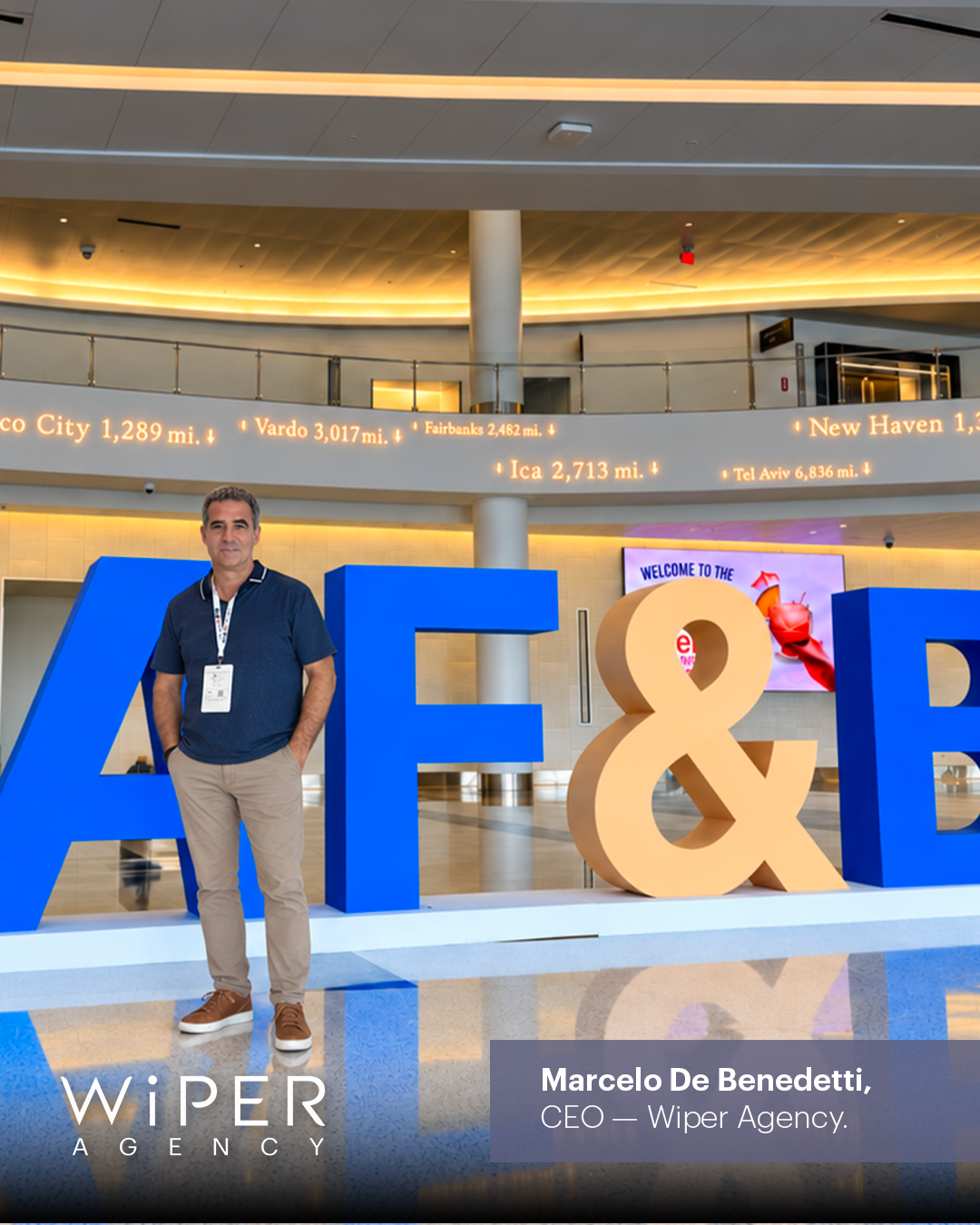
Three days, one convention center, and a very clear pattern in almost every conversation we had:
Brands from Latin America and Europe are eager to enter the U.S. market, and most of them are thinking about it as a distribution problem.
It isn't. Or rather, it isn't only that.
Last week, our team joined thousands of food and beverage professionals at the Americas Food & Beverage Show in Miami — an event marking its 30th anniversary this year.
AFB Show is built, first and foremost, to connect exhibitors with buyers — retailers, distributors, importers, foodservice operators. That's the stated purpose, and it delivers on it well. But walking the floor and sitting in on conversations with founders and brand teams, what stood out wasn't the deal-making itself. It was how many of those conversations eventually circled back to a different question: okay, we have a distributor — now what makes the consumer choose us?
That gap is where we think events like this one matter most, even beyond their B2B purpose. For a brand trying to cross into the U.S., finding the right agency or strategic partner early — someone who understands both where the brand comes from and who it's now trying to reach — can matter as much as finding the right distributor. Distribution gets the product onto a shelf. It doesn't explain to the shelf's next customer why they should care.
“For a Hispanic or European brand, entering the U.S. is about much more than distribution. You need to understand the consumer, the category and the cultural codes that drive purchase decisions. Having a product in the U.S. is one thing; making it culturally relevant is another.” — Marcelo Benedetti, CEO of Wiper Agency.
The growth story behind this is real. Hispanic consumers represent close to a fifth of the U.S. population, with significant and growing purchasing power, and Hispanic-owned and Latin American brands are showing up in U.S. retail at a pace we haven't seen before. That's genuinely good news. But growth in volume of brands entering the market doesn't automatically translate into growth in relevance for each one of them. A crowded shelf is still a shelf where most products remain invisible to the person standing in front of it.
That's the part that doesn't get talked about enough at events like this. A product can check every distribution box — imported, priced, stocked, listed on Amazon — and still mean nothing to the consumer picking it up, because meaning isn't something logistics can deliver. It's built through understanding how a category is perceived, what a shopper already believes about it, and where a brand's own story either confirms or contradicts that belief. This is true for the American consumer broadly, and it becomes more nuanced, not simpler, when the audience is Hispanic — a demographic that's often treated as one market when it's really several, shaped by generation, geography, and how closely each person's daily life still connects to the country their family came from.
None of this is an argument against events like AFB Show — quite the opposite. If anything, we left the event more convinced that this kind of in-person, high-density moment is exactly where brands should be asking the harder question, not just the logistical one. The deals get made on the floor. The relevance gets built somewhere else — in research, in positioning, in the work of translating not just language but context.
Being available in the U.S. is a milestone. Being understood by the person deciding whether to buy is a different, longer project — and it's the one that actually determines whether that first shelf placement turns into a second order.
Por Wiper Agency.
